

Table turnover rate tells you how well hotel restaurants transform tables into money by counting how many times different groups of guests sit at the same table throughout service hours. For hotel managers and hospitality operators that run restaurants, resort dining facilities, or vacation rental food services on their properties, knowing how to use this indicator is the key to figuring out if eating operations make the business more or less profitable.
This blog article is all about how to make table turnover better for hotel restaurants, resort dining venues, and food service organizations that serve more than one location. Restaurant managers in standalone businesses will discover useful ideas, but the major focus is still on hospitality settings where dining is part of a larger visitor experience management. The information is meant for hotel general managers, food and beverage directors, and revenue management specialists who want to improve the efficiency of all dining operations.
To find the table turnover rate, divide the number of parties served by the number of tables that were available during a certain time. A hotel breakfast service with 30 tables and 120 seats has a 4-turn rate, which means that four different groups sat at each table that morning.
You will know how to do the following by the end of this guide:
- Calculate and benchmark your restaurant’s table turnover rate against industry standards
- Implement technology solutions that integrate dining data with property management systems
- Balance faster table turnover with overall customer satisfaction
- Optimize staffing and service workflows during peak periods
- Increase revenue without expanding physical dining space

Understanding Table Turnover in Hospitality
The restaurant table turnover rate tells you how many times a single table may hold different groups of guests during a set service window. This indicator shows the difference between available seating and actual income for hotel and resort dining operations. For example, a restaurant with 20 tables that rotates over three times every dinner service effectively runs as a 60-table venue in terms of client throughput.
This is very important for hotel profits because restaurants compete for limited space on the property. Hotel dining has to make the most of its space compared to other usage, unlike restaurants that are only open for business. How well a restaurant runs immediately affects whether that space is profitable or needs to be turned into conference rooms or stores.
Hotel Restaurant Dynamics
Restaurant table turnover rate works differently in hotels depending on the sort of service. Breakfast service usually requires greater turnover rates because customers need quick nourishment before meetings or activities. This means that 30–45 minute turns are both normal and expected. All-day dining venues face variable patterns, with business travelers seeking quick lunches while leisure guests prefer lingering afternoon meals.
Hotels with specialty eateries add another layer of interest. Fine dining restaurants try to keep their staff longer so they can give customers better service and charge more for it. The math for the restaurant company changes: fewer parties served times a lot more money made each party might add up to more money than a lot of informal places.
These patterns of turnover are strongly related to how hotels manage their entire revenue. Properties that keep track of visitor satisfaction levels generally find that complaints about the dining experience are linked to either long wait times (which create bottlenecks) or hurrying guests through meals (which puts turnover ahead of experience). To find balance, you need to think of table turn time as one part of a larger plan to improve the client experience.
Resort and Multi-Property Considerations
Managing several restaurants in a resort property is much more difficult. A single property could have a grab-and-go café that gets 8 to 10 customers a day, a poolside restaurant that gets 3 to 4 customers during peak hours, and a signature restaurant that is happy with 1.5 customers every evening seating. Each venue needs different turnover goals that fit with its service model and the needs of its guests.
Comparative analysis helps multi-property operators go ahead. When one resort's breakfast venue has higher table turnover rates than its sister resorts on a regular basis, it could mean that there are operational best practices that should be copied or that there are contextual variables that need to be looked into. Data from the past on different properties can help us understand what causes turnover to change.
The link between dining efficiency and the overall profitability of a hotel goes beyond just income. Properties with smooth dining operations, short wait times, predictable service times, and happy guests, tend to get better evaluations and more return reservations. So, optimizing restaurant table turnover rate helps the overall success of the hotel.
Comprehending these fundamental principles equips us to explore specific measurement methodologies that convert turnover from an abstract notion into a practical metric.
Calculating and Measuring Table Turnover Rate
To go from understanding ideas to putting them into practice, you need to learn how to use calculating procedures that give you accurate, useful data. There are different ways to do calculations that can help hotel dining operations, depending on what decisions the data can help with.
Basic Calculation Formula
The basic way to figure out the table turnover rate is to divide the number of parties served by the number of tables available at that time:
Table Turnover Rate = Parties Served ÷ Available Tables
Think about a hotel breakfast place with 25 tables that serves 100 full parties from 6:30 AM to 10:30 AM. The math shows that each table had four different groups on average throughout breakfast service (100 ÷ 25 = 4).
Dinner runs longer. The same restaurant turns 75 covers across 25 tables in five hours. Three turns per table. Math: 75 ÷ 25 = 3. Dinner pacing pulls revenue, not table count.
Lunch sits between dinner and breakfast. Picture a hotel restaurant turning 50 covers across 25 tables in a 2.5-hour window. Two turns. Could be a ceiling. Could just be the business-traveler crowd lingering over a working lunch. The fix depends on which one. Cutting a relaxed lunch backfires fast.
Time Period Considerations
Choosing the right measurement periods has a big effect on how helpful the data is. Even though the venue is open from 6:00 AM to 11:00 AM, breakfast rush analysis can focus on the 7:00 AM to 9:00 AM window, when business guests eat. When you measure turnover over the whole operating window, you lose sight of peak performance since you average in slower early and late periods.
Seasonal changes mean that measurement methods need to be planned carefully, especially for resort properties. During the summer, a beachside restaurant might have four turns per dinner service. In the shoulder seasons, it might only have two. Comparing the same time period from one year to the next gives you more useful information than comparing months to months, which mix up changes in operations with variations in the seasons.
Weekly patterns are also important to look at. During the week, hotel restaurants usually have distinct patterns of customers (business travelers who want to eat quickly) than on the weekends (leisure guests who want to eat for a long time). Instead of trying to find a single average table turnover rate that works for all types of days, restaurant managers should set various criteria for each type of day.
Performance Benchmarks
Use industry standards as a guide to compare your restaurant's table turnover to that of other restaurants:
| Service Type | Target Turns | Optimal Table Turn Time |
|---|---|---|
| Hotel Breakfast | 4-6 turns | 30-45 minutes |
| Quick Service/Café | 6-8 turns | 20-30 minutes |
| Casual All-Day | 2-3 turns | 60-75 minutes |
| Upscale Casual | 2-2.5 turns | 75-90 minutes |
| Fine Dining | 1-2 turns | 90-120 minutes |
These standards are not exact goals, but rather healthy ranges. If a fine dining restaurant only gets one turn per night, it might not be doing well, or it might be following a planned strategy of long tasting menus with high per-guest income. Whether a benchmark deviation means there is a problem or it was done on purpose depends on the situation.
Most people in the restaurant business think that the average table turnover rate for all types of dining is three turns every meal service. For casual operations, the best time to turn over a table is about 45 minutes. Properties that repeatedly fall below these averages should look into operational problems before assuming that underperformance is normal.
Once you know the basics of measuring, making strategic improvements is more about following a plan than guessing.
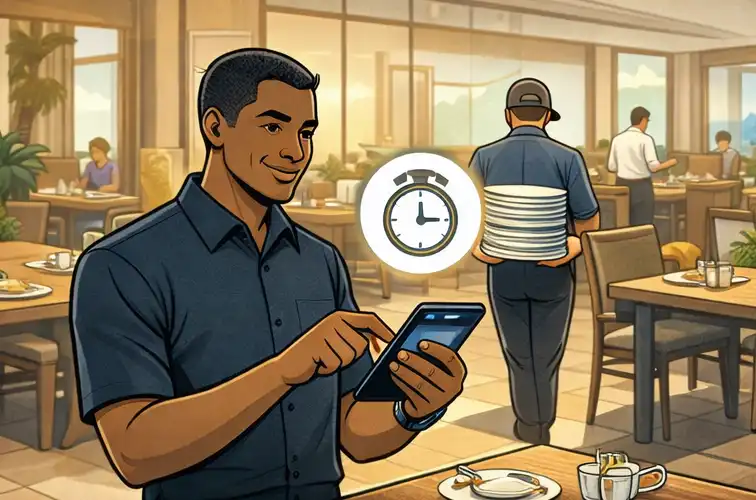
Strategic Implementation for Hotel Dining Operations
To turn turnover stats into better operations, you need to use technology, set up the right service models, and get everyone on the same page about how to be more efficient without ruining the dining experience.
Technology Integration Process
Modern hotel dining operations gain significant advantages from interconnected technology that deliver data insights without necessitating manual tracking. The steps for implementation are as follows:
- Link your dining POS systems to your property management system. This way, the two systems can automatically compare dining turnover with property occupancy, showing how the mix of guests affects restaurant performance. This connection also makes it easier to charge rooms, which speeds up the time it takes to process payments at the table.
- Use real-time table management dashboards. These visual displays highlight the current state of tables, the average time it takes to turn a table, and the depth of the waitlist. This lets hosts and restaurant managers make quick decisions about seating. Staff can quickly observe which sections are turning tables quickly and which ones require help.
- Set up automated reporting for turnover metrics. Scheduled reports make sure that measurements are always the same and do away with the need for manual calculations. Daily summaries that highlight the number of parties served, the average length of time they were there, and the turnover by time period make people responsible and show trends.
- Get the front-of-house team fluent on the system. Servers update table status the moment a check drops. Hosts juggle next-up parties against the seating-cycle target. Managers read the dashboard during the rush, not after. Without that fluency the system is just a screen nobody trusts.
Software gets the manager out of reactive mode. The dashboard surfaces a pattern (Tuesday dinner consistently turns slower than other weekdays), and the manager runs the diagnostic on Wednesday. Maybe a Tuesday-only promo is bringing in slower-spending parties. Maybe the staffing template is undersized that night. Maybe the kitchen ticket times spike at 7:30 because of Tuesday's prep schedule. Each cause has a different fix.
Service Model Comparison
Different dining situations call for different turnover goals. Hotel management need to adapt expectations to the sort of service rather than trying to make everything work the same way:
| Service Type | Target Turnover Rate | Optimal Duration | Key Drivers |
|---|---|---|---|
| Hotel Breakfast | 4-6 turns | 30-45 minutes | Pre-set items, efficient beverage service, contactless payment options |
| Casual Dining | 2-3 turns | 60-75 minutes | Simplified menu size, proactive check delivery |
| Fine Dining Establishments | 1-2 turns | 90-120 minutes | Course pacing, sommelier engagement, post-meal offerings |
| Poolside/Outdoor | 3-4 turns | 45-60 minutes | Weather-dependent, simplified menu items |
Fine dining restaurants choose to charge more for meals instead of having more tables turn over. A restaurant that turns tables twice a night at $200 per guest does better than one that flips tables four times a night at $60. For high-end places, revenue per available seat hour is more important than sheer turnover.
Casual businesses have the opposite problem. When check averages are low, the way to make money is to serve more clients instead of getting more money from each one. These places should work hard to get people to leave the table faster by simplifying the menus, choreographing the service, and putting in place technologies that cut down on payment delays.
Resort facilities with a variety of dining options and restaurant business should set different goals for each one instead of using the same rules for all of them. A single property might have a great 5-turn breakfast performance while only aiming for 1.5 turns at its signature restaurant. Both of these are great examples of how to do things right in their own way.
Knowing what the right goals are for each service model helps restaurant industry get ready for the problems that will come up during implementation.
Challenges and Solutions
Even the best turnover optimization programs run into problems. Anticipating typical problems lets you find answers before they happen instead of putting out fires after they happen.
Inconsistent Service During Peak Seasons
When there are a lot of guests at once, restaurants have a hard time keeping up with demand. When occupancy goes higher, properties that staff and run for typical demand have a hard time keeping up, which causes service delays that hurt turnover rates at the worst possible time.
Use dynamic staffing models that are based on occupancy projections and previous turnover data. If your business usually gets 15% more restaurant customers when hotel occupancy is over 90%, schedule more servers when reservations show that the hotel is full. Use data from prior peak times to properly forecast how many staff members you will need, and train staff from other departments at the hotel to work in the dining room during busy times.
Guest Experience vs. Efficiency Balance
Management has to deal with the continuous problem of balancing faster turnover with a good visitor experience. If you push too hard for efficiency, you could make guests leave bad evaluations. If you don't pay attention to turnover, your profits will go down and other guests will have to wait longer than necessary.
You can determine the best point of optimization by combining visitor input with turnover analytics. If customers who eat at busy times are just as happy as those who eat during slack times, it means that efficiency measures aren't hurting the experience. When scores are different, look into the precise service touchpoints that are causing problems. People often complain not about fast service but about feeling rushed. Training servers to talk to customers confidently without feeling rushed keeps customers happy and helps meet turnover targets.
Multi-Venue Coordination
Properties with more than one restaurant have trouble keeping track of all the information. When each restaurant keeps track of its own turnover, it misses out on chances to redistribute guests and make the most of its space. Guests who are waiting 40 minutes for popular places may not know that there are other places available right away.
Use unified management dashboards to see how many people are leaving each of your property's eating locations. When one restaurant enters high-wait status while another shows available capacity, host staff can redirect guests appropriately, but only with real-time cross-venue visibility. This cooperation also helps the kitchen work better by letting them know when several venues are having high-demand times at the same time, so they can plan ahead.
Addressing these problems sets up dining operations for long-term improvement instead of short-term wins that fall apart when things become tough.

Conclusion and Next Steps
The table turnover rate is one of the most important numbers that shows if hotel dining activities make the business more profitable or just take up valuable space. Properties that regularly monitor, compare, and improve turnover make more money from their current seating capacity while keeping the quality of the visitor experience high.
The balance is important. Trying to get tables to turn over faster without thinking about how it affects the customer experience hurts your reputation and your ability to make money in the long run. On the other hand, letting inefficient operations continue because of ambiguous hospitality ideals costs money. In some cases, customers who stay too long restrict more tables from serving other guests who would be happy to pay.
Immediate next steps:
- Audit current turnover rates across all dining venues, establishing baseline measurements using the parties served divided by available tables formula
- Compare baseline rates against industry benchmarks appropriate to each venue’s service model
- Implement or upgrade measurement systems connecting POS data with table management
- Train entire team on efficiency protocols that enhance rather than compromise service quality
- Review technology integration options connecting dining operations with property management systems
For a more in-depth look, think about revenue management integration methods that change the number of available reservations based on how well turnover is expected to happen. Multi-property reporting solutions give operators that manage portfolios more value by letting them compare performance and find best practices across sites.
Additional Resources
Benchmarking Tools:
- Black Box Intelligence provides restaurant industry performance data including turnover metrics
- Restaurant365 offers POS-integrated reporting suitable for multi-venue operations
- Property-specific historical data remains your most relevant benchmark source
Technology Integration:
- Evaluate PMS vendors’ dining module capabilities before selecting separate systems
- Prioritize solutions offering real-time table status visibility across all property venues
- Consider mobile payment integration to reduce payment processing time per table
Staff Development:
- Pre-shift briefings reviewing previous day’s turnover performance create accountability
- Service choreography training focusing on timing without rushing guests improves turn times
- Cross-training programs expand staffing flexibility during peak demand periods